
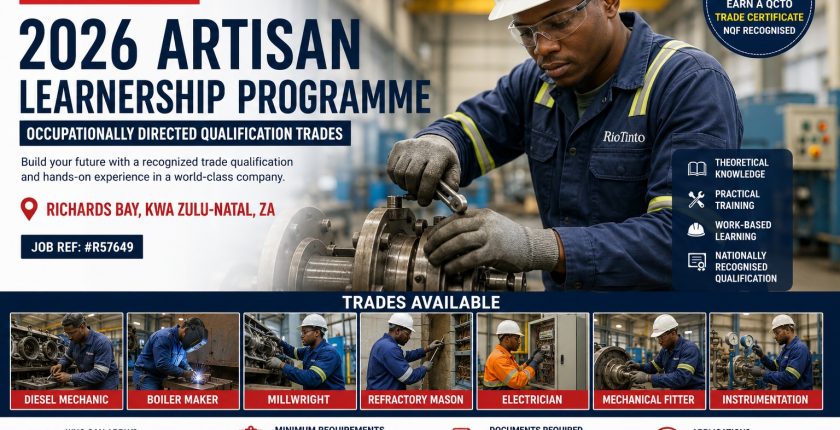
2026 Artisan Learnership Programme Rio Tinto – How to Apply
2026 Artisan Learnership Programme at Rio Tinto – How to Apply. Apply for the 2026 Artisan Learnership Programme at Rio Tinto in Richards Bay, KwaZulu-Natal. Learn about requirements, trades available, application process, benefits, salary expectations, career opportunities, and how unemployed South African youth in King Cetshwayo District can qualify for artisan training and QCTO Trade Certificates.
South Africa continues to face a major challenge of youth unemployment, especially among young people searching for opportunities in technical and engineering fields. One of the best ways to build practical skills and gain industry-recognized qualifications is through artisan learnerships. The 2026 Artisan Learnership Programme offered by Rio Tinto presents an excellent opportunity for unemployed youth who want to build successful careers in engineering and technical trades.
This exciting opportunity is based in Richards Bay and focuses on Occupationally Directed Qualification Trades. The programme combines theoretical learning, practical training, and workplace experience to ensure learners develop the skills needed in modern industry environments.
If you are passionate about becoming an artisan and want to work in mining, engineering, manufacturing, or industrial maintenance, this programme could be the ideal starting point for your career.
About Rio Tinto
Rio Tinto Official Website is one of the world’s leading mining and metals companies. The company operates globally and is known for producing materials essential for human progress, including iron ore, aluminium, copper, and minerals used in modern technology and infrastructure.
Rio Tinto has built a strong reputation for investing in employee development, safety, diversity, and sustainability. Through learnerships, apprenticeships, and graduate programmes, the company helps young people gain valuable skills and industry experience.
The company’s South African operations continue to create opportunities for local communities by supporting skills development and employment initiatives.
What is the 2026 Artisan Learnership Programme?
The 2026 Artisan Learnership Programme is a structured occupational training programme designed to prepare learners for artisan careers in technical trades.
This accredited programme is aligned with the National Qualifications Framework (NQF) and leads to a recognized Trade Certificate issued by the Quality Council for Trades and Occupations (QCTO).
The programme combines:
- Classroom-based theoretical learning
- Practical workshop training
- Real workplace experience
- Skills assessments and trade testing
The main goal is to equip learners with the technical competence and practical experience required to work as qualified artisans in South Africa’s industrial and mining sectors.
Trades Available in the Programme
The learnership offers training opportunities in several highly sought-after artisan trades.
Diesel Mechanic
Diesel mechanics specialize in maintaining and repairing diesel-powered vehicles and machinery used in industrial and mining environments.
Responsibilities include:
- Diagnosing engine problems
- Servicing heavy-duty machinery
- Repairing hydraulic systems
- Maintaining mining equipment
Diesel mechanics are in high demand across mining, logistics, construction, and transport industries.
Boiler Maker
Boiler makers fabricate, assemble, install, and repair metal structures, boilers, tanks, and industrial equipment.
Skills learned:
- Welding
- Metal fabrication
- Reading technical drawings
- Structural assembly
This trade is essential in mining plants, factories, and industrial operations.
Millwright
Millwrights work with both mechanical and electrical systems. They install, maintain, and repair industrial machinery.
Key duties:
- Troubleshooting machinery faults
- Mechanical maintenance
- Electrical repairs
- Equipment installation
Millwrights are among the most versatile artisans in South Africa.
Refractory Mason
Refractory masons install and repair heat-resistant materials in furnaces, kilns, and industrial equipment.
Duties include:
- Bricklaying with refractory materials
- Furnace maintenance
- Heat insulation work
- Industrial lining installation
This trade plays a critical role in heavy industrial environments.
Electrician
Electricians install, maintain, and repair electrical systems in industrial facilities.
Learners will gain experience in:
- Electrical wiring
- Fault finding
- Motor control systems
- Electrical safety procedures
Electricians remain one of the most in-demand trades in South Africa.
Mechanical Fitter
Mechanical fitters assemble, maintain, and repair machinery and mechanical systems.
Training includes:
- Machine alignment
- Equipment maintenance
- Bearing replacement
- Mechanical troubleshooting
This trade provides opportunities in manufacturing, mining, and engineering sectors.
Instrumentation
Instrumentation artisans focus on automated control systems and industrial instruments.
Skills covered:
- Process control systems
- Calibration
- Instrument maintenance
- Automation technology
Instrumentation is a highly specialized and well-paying trade.
Why This Learnership is Important
The 2026 Artisan Learnership Programme is more than just training. It provides a pathway toward stable employment and long-term career growth.
Industry-Relevant Skills
Learners receive hands-on experience using real industrial equipment and systems.
Nationally Recognized Qualification
Successful candidates receive a Trade Certificate recognized across South Africa.
Work Experience
Employers value candidates who already have workplace exposure.
Career Opportunities
Qualified artisans can work in:
- Mining
- Manufacturing
- Energy
- Construction
- Transport
- Engineering companies
Minimum Requirements
To qualify for the programme, applicants must meet several important criteria.
Educational Requirements
Applicants must have:
- Grade 12/Matric
- Mathematics (Core Mathematics)
- Physical Science or Technical Matric
Trade-related qualifications may provide an added advantage.
Citizenship Requirements
Applicants must:
- Be South African citizens
- Be unemployed youth
Driver’s License
Candidates must possess:
- A valid South African driver’s license
- Minimum Code B license
Learnership Status
Applicants:
- Must not currently be registered for another learnership or apprenticeship funded by a SETA or private organization
Residential Requirements
Applicants must reside within:
- King Cetshwayo District Municipality
- KwaZulu-Natal
This requirement ensures the programme benefits local communities.
Required Application Documents
Candidates must submit the following:
Curriculum Vitae (CV)
Your CV should include:
- Personal details
- Educational qualifications
- Skills
- Contact information
- Any technical experience
Certified Matric Certificate
Applicants must attach:
- Certified copy of Grade 12 certificate
Certified Trade Qualification
If applicable:
- Include certified copies of trade-related qualifications
How to Prepare a Strong Application
Competition for artisan learnerships is usually very high. Preparing a professional application can improve your chances significantly.
Create a Professional CV
Your CV should:
- Be clear and organized
- Avoid spelling mistakes
- Highlight technical subjects and achievements
- Include practical skills
For CV writing guidance, visit:
Career325 CV Tips
Certify Documents Correctly
Ensure all documents:
- Are clearly readable
- Are recently certified
- Match the information on your application
Highlight Technical Interest
Mention:
- Engineering interests
- Technical hobbies
- School projects
- Practical experience
Benefits of Joining an Artisan Learnership
Artisan learnerships offer several important advantages.
Earn While Learning
Many learnerships provide:
- Monthly stipends
- Practical training allowances
Practical Experience
Learners gain real-world exposure that improves employability.
Professional Development
The programme develops:
- Technical skills
- Communication skills
- Problem-solving abilities
- Workplace discipline
Employment Opportunities
Qualified artisans are highly employable in:
- Mining companies
- Factories
- Municipalities
- Engineering firms
Why Artisan Careers are in High Demand
South Africa continues to experience a shortage of qualified artisans.
Industries require skilled workers to maintain and repair equipment critical for production and operations.
Sectors Hiring Artisans
Qualified artisans can find opportunities in:
- Mining
- Manufacturing
- Automotive
- Energy
- Construction
- Oil and gas
Expected Salary for Qualified Artisans
Salaries vary depending on:
- Industry
- Experience
- Trade specialization
- Location
However, qualified artisans often earn competitive salaries in South Africa.
Approximate earning potential:
- Entry-level artisans: R15,000 – R25,000 monthly
- Experienced artisans: R30,000 – R60,000+ monthly
Specialized trades such as instrumentation and millwrights may earn even more.
Importance of QCTO Trade Certificates
The Quality Council for Trades and Occupations (QCTO) ensures trade qualifications meet national standards.
Benefits of a QCTO Trade Certificate include:
- National recognition
- Better employment prospects
- Career mobility
- Qualification credibility
Skills You Will Develop During the Programme
Learners gain both technical and workplace skills.
Technical Skills
- Equipment maintenance
- Troubleshooting
- Welding
- Electrical work
- Mechanical repairs
Soft Skills
- Teamwork
- Communication
- Time management
- Workplace safety awareness
Richards Bay as an Industrial Hub
Richards Bay is one of South Africa’s major industrial and mining regions.
The city hosts:
- Large mining operations
- Manufacturing plants
- Port facilities
- Industrial processing plants
This creates excellent opportunities for technical professionals and artisans.
Tips for Succeeding in an Artisan Learnership
Stay Disciplined
Arrive on time and take training seriously.
Ask Questions
Learn from experienced artisans and mentors.
Focus on Safety
Industrial environments require strict adherence to safety procedures.
Practice Continuously
Technical skills improve through repetition and hands-on practice.
Career Growth After Qualification
After becoming a qualified artisan, career growth opportunities may include:
Senior Artisan Roles
Experienced artisans can supervise teams and maintenance operations.
Technical Specialist Positions
Specialized artisans may work on advanced systems and technologies.
Engineering Studies
Some artisans continue studying toward engineering diplomas or degrees.
Entrepreneurship
Qualified artisans can start their own businesses.
Other Learnership Opportunities in South Africa
If you are interested in additional opportunities, you can explore:
- Mining learnerships
- Eskom learnerships
- Transnet apprenticeships
- Engineering internships
You can find more opportunities here:
Career325 Learnerships
How Learnerships Help Reduce Youth Unemployment
Learnerships bridge the gap between education and employment.
They provide:
- Industry exposure
- Recognized qualifications
- Practical work experience
- Employment pathways
Programmes like the Rio Tinto Artisan Learnership are critical for empowering South African youth.
Common Mistakes to Avoid When Applying
Incomplete Applications
Ensure all required documents are attached.
Incorrect Contact Details
Double-check your phone number and email address.
Poorly Written CVs
Professional presentation matters.
Late Applications
Submit your application before the closing date.
Resources for Applicants
Useful resources include:
Final Thoughts
The 2026 Artisan Learnership Programme offered by Rio Tinto is an outstanding opportunity for unemployed South African youth who want to build successful technical careers.
With training opportunities in trades such as diesel mechanic, electrician, millwright, instrumentation, and boiler making, this programme provides valuable skills that are highly demanded across multiple industries.
Learners will benefit from structured training, practical workplace experience, and nationally recognized qualifications that can open doors to long-term employment and career growth.
If you meet the requirements and are passionate about engineering and technical work, this learnership could be the first step toward a rewarding future in South Africa’s industrial sector.
For more South African learnerships, internships, and career opportunities, visit:
Career325
Find more Learnerships
