
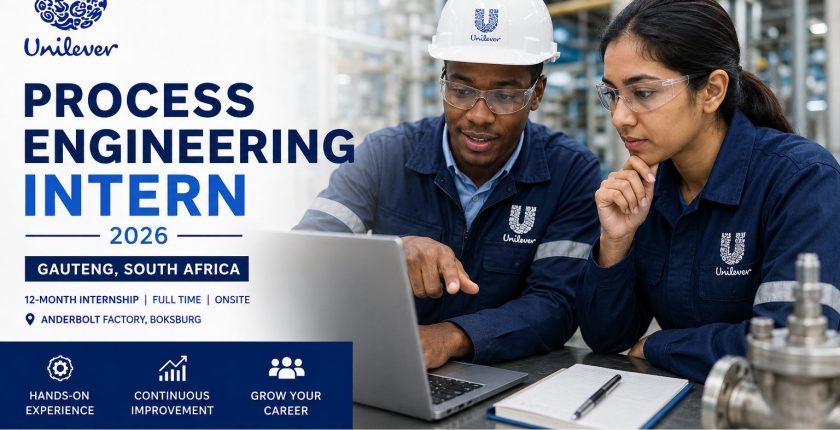
Unilever Process Engineering Intern 2026 Opportunity in Gauteng: How to Apply
Apply for the Unilever Process Engineering Intern 2026 opportunity in Gauteng. Learn about requirements, duties, skills, benefits, and application tips.
South African graduates looking to launch their engineering careers now have an exciting opportunity to join one of the world’s leading consumer goods companies. Unilever has opened applications for its Process Engineering Intern position based at the Anderbolt Factory in Boksburg, Gauteng.
This 12-month internship offers recent graduates the chance to gain practical experience in manufacturing, process optimization, continuous improvement, and world-class production systems while working alongside experienced professionals in a globally recognized organization.
For graduates in Chemical Engineering, Mechanical Engineering, Industrial Engineering, or Electrical Engineering, this internship represents an excellent opportunity to develop technical expertise and build a strong foundation for a successful engineering career.
About Unilever
Unilever is one of the world’s largest fast-moving consumer goods (FMCG) companies, producing household brands that millions of people use every day. The company operates in over 190 countries and is known for its commitment to sustainability, innovation, operational excellence, and employee development.
Working at Unilever provides graduates with exposure to global best practices, advanced manufacturing technologies, and continuous improvement methodologies that are highly valued across industries.
Official Website: https://www.unilever.com
Internship Overview
Position Details
Job Title: Process Engineering Intern
Job ID: R-1182288
Location: Anderbolt Factory, Boksburg, Gauteng, South Africa
Department: Supply Chain
Duration: 12 Months
Employment Type: Full-Time Internship
Work Arrangement: On-site (100% attendance required)
Reporting To: Unit Manager / Operational Lead
Application Status: Open
The internship is designed to provide practical exposure to manufacturing operations while developing technical, analytical, and problem-solving capabilities.
Purpose of the Internship
The primary objective of the Process Engineering Intern role is to support safe, efficient, and high-quality manufacturing operations through the application of the Unilever Manufacturing System (UMS).
Interns will work closely with operational teams to identify inefficiencies, eliminate waste, improve process performance, and contribute to continuous improvement initiatives.
Throughout the internship, graduates will gain valuable experience in:
- Manufacturing operations
- Process optimization
- Equipment reliability
- Quality assurance
- Data analysis
- Problem-solving methodologies
- Continuous improvement systems
The role also offers an opportunity to understand how large-scale manufacturing facilities maintain world-class standards in safety, productivity, and quality.
Why This Internship Is Valuable
Engineering graduates often struggle to gain practical industrial experience after completing their studies.
The Unilever Process Engineering Internship bridges this gap by allowing interns to:
- Apply theoretical knowledge in real-world manufacturing environments
- Learn from experienced engineers
- Work on improvement projects with measurable impact
- Gain exposure to internationally recognized manufacturing systems
- Build professional networks
- Enhance employability within the engineering sector
Employers highly value candidates who possess both academic qualifications and practical manufacturing experience.
Key Responsibilities
Successful candidates will be involved in several operational and engineering activities.
1. Support Continuous Improvement Initiatives
Interns will assist in reducing operational losses through the implementation of Unilever Manufacturing System methodologies.
These include:
- Autonomous Maintenance (AM)
- Planned Maintenance (PM)
- Focused Improvement (FI)
- Quality Pillars (Q)
The objective is to improve efficiency while minimizing waste.
2. Process Data Collection and Analysis
Data-driven decision-making is essential in manufacturing.
Interns will:
- Collect process performance data
- Verify data accuracy
- Analyze trends
- Identify production losses
- Recommend improvement opportunities
These activities help ensure operational stability and efficiency.
3. Root Cause Analysis
One of the most important engineering skills is identifying the source of problems.
Interns will participate in:
- Investigating production issues
- Performing Root Cause Analysis (RCA)
- Developing corrective actions
- Monitoring implementation effectiveness
This experience strengthens analytical and troubleshooting capabilities.
4. Run-to-Standard Activities
Interns will contribute to Run-to-Standard (R2S) initiatives by supporting:
- Loss prioritization
- Data gathering
- SMED projects
- Equipment setting optimization
- Process parameter standardization
These activities help improve manufacturing consistency and reliability.
5. Technical Standards Development
Maintaining standardized processes is critical for operational excellence.
Interns will help:
- Develop technical standards
- Update process documentation
- Maintain operating procedures
- Improve process stability
This ensures consistency across manufacturing operations.
6. Training and Knowledge Sharing
A key aspect of engineering leadership involves sharing knowledge.
Interns may assist in:
- Operator training
- Standards implementation
- Problem-solving workshops
- Process restoration activities
These experiences help develop communication and leadership skills.
7. Waste Reduction and Yield Improvement
Manufacturers continuously seek ways to reduce waste and improve product yields.
Interns will support projects focused on:
- Waste minimization
- Yield optimization
- Cost reduction
- Efficiency improvements
These projects often have direct financial benefits for the organization.
8. Material Efficiency Analysis
The role includes evaluating how effectively materials are used during production.
Activities include:
- Material Usage Variance (MUV) analysis
- BOM validation
- Process standard reviews
- Material consumption optimization
This supports sustainability and cost-efficiency goals.
9. Chemical Mass Balance Analysis
Engineering interns will gain exposure to process calculations and system optimization.
Responsibilities may include:
- Material flow analysis
- Batch process evaluation
- Process set-point optimization
- Production efficiency assessments
These tasks provide valuable technical development opportunities.
Qualifications Required
To qualify for the internship, applicants must possess one of the following qualifications:
Bachelor of Science (B.Sc.) or Bachelor of Technology (B.Tech) in:
- Chemical Engineering
- Mechanical Engineering
- Industrial Engineering
- Electrical Engineering
Recent graduates and individuals seeking practical industry exposure are encouraged to apply.
Essential Technical Skills
World Class Manufacturing (WCM) Tools
Knowledge of the following tools will be advantageous:
- Autonomous Maintenance (AM)
- Planned Maintenance (PM)
- Focused Improvement (FI)
- Quality Control (QC)
Root Cause Analysis
Candidates should understand basic problem-solving methodologies used to identify and eliminate operational issues.
Examples include:
- 5 Whys
- Fishbone Diagrams
- Failure Analysis Techniques
Data Analysis
The ability to analyze production data and identify trends is highly beneficial.
Graduates familiar with:
- Excel
- Statistical Analysis
- Process Monitoring
- Manufacturing KPIs
may have an advantage.
OEE Monitoring
Understanding Overall Equipment Effectiveness (OEE) can help candidates stand out.
OEE focuses on:
- Availability
- Performance
- Quality
and serves as a key manufacturing performance metric.
Soft Skills Required
In addition to technical abilities, Unilever seeks candidates who demonstrate:
Communication Skills
The ability to communicate effectively with operators, engineers, and management teams.
Teamwork
Working collaboratively across departments is essential in manufacturing environments.
Problem-Solving
Engineers must be able to identify challenges and develop practical solutions.
Adaptability
Manufacturing environments are dynamic and require flexibility.
Accountability
Interns must demonstrate ownership and responsibility in their assigned tasks.
Benefits of Working at Unilever
Joining Unilever offers numerous professional advantages.
Industry Experience
Gain hands-on experience in a globally recognized manufacturing environment.
Mentorship
Work alongside experienced professionals who can guide career development.
Technical Exposure
Learn advanced manufacturing systems and continuous improvement methodologies.
Career Development
Many successful careers begin through internships that provide valuable workplace exposure.
Networking Opportunities
Build relationships with industry professionals and future employers.
How to Prepare for the Application
To improve your chances of success, consider the following tips:
Update Your CV
Ensure your CV highlights:
- Academic achievements
- Engineering projects
- Leadership experience
- Technical software skills
- Practical training
For guidance, read:
How to Write a Winning CV:
How to write a winning CV
Prepare for Engineering Interviews
Expect questions on:
- Process improvement
- Problem-solving
- Engineering principles
- Teamwork experiences
- Manufacturing systems
Read:
How to Ace Virtual Job Interviews:
https://career325.com/how-to-ace-virtual-job-interviews/
Strengthen Your Engineering Knowledge
Review concepts such as:
- Process Control
- Manufacturing Systems
- Quality Management
- Lean Manufacturing
- Root Cause Analysis
Career Opportunities After the Internship
Experience gained during this internship can lead to careers such as:
- Process Engineer
- Manufacturing Engineer
- Production Engineer
- Industrial Engineer
- Continuous Improvement Engineer
- Maintenance Engineer
- Operations Engineer
- Supply Chain Engineer
The skills developed are transferable across multiple industries including:
- FMCG
- Mining
- Automotive
- Energy
- Chemical Processing
- Food Manufacturing
Diversity and Inclusion at Unilever
Unilever is committed to fostering a workplace that values diversity, equity, and inclusion.
The company encourages applications from candidates of all backgrounds and seeks to build a workforce that reflects South Africa’s diverse population.
Employment Equity and Broad-Based Black Economic Empowerment (B-BBEE) principles are considered during recruitment processes.
The organization also supports applicants who may require reasonable accommodations during the recruitment journey.
Why Engineering Graduates Should Apply
The Unilever Process Engineering Internship is more than just an internship—it is an opportunity to build a strong engineering foundation within a globally respected organization.
Graduates will gain:
- Real-world manufacturing experience
- Exposure to world-class systems
- Technical and leadership development
- Problem-solving expertise
- Valuable industry connections
For ambitious engineering graduates seeking to launch their careers in manufacturing and supply chain operations, this opportunity provides an excellent starting point.
Apply for the Unilever Process Engineering Internship
Interested candidates should submit their applications through the official Unilever Careers portal before the vacancy closes.
This internship offers a unique opportunity to gain practical engineering experience while contributing to operational excellence at one of the world’s most respected consumer goods companies. If you meet the requirements and are passionate about engineering, manufacturing, and continuous improvement, don’t miss this opportunity to kick-start your professional journey with Unilever.
